35% vs 67%
Retention or graduation of autistic students compared with their peers, as reported in a recent systematic review.
Koops et al., 2025 [10]Pilot randomized trial · Jordan
Does immersive VR improve academic interaction more than the same practice on a screen? A pilot randomized comparison in Jordan.
Answering, asking, discussing and presenting are expected in most university courses, yet no training tools are designed for autistic students. This 16-week project tests whether practising in a virtual classroom, where the student controls class size, noise and pace, improves their participation in real classes.
Duration: 16 weeks (4 months), including 2 months of development
01
More autistic students reach university, but far fewer finish. Speaking up in class is part of almost every course, and there is nothing designed to help them practise it. [10]
Retention or graduation of autistic students compared with their peers, as reported in a recent systematic review.
Koops et al., 2025 [10]Autistic vs non-autistic students who had considered dropping out (63 and 268 UK students).
Cage & McManemy, 2022 [3]Only one study from Jordan among assistive-technology studies on autism in Arab countries, and it involved children aged 5–13. None addressed adults or university students.
Al-Hendawi et al., 2023 [1]02
Three findings point to the same gap: simulation can work, but its effects rarely reach real life.
Competitive integrated employment within six months in a randomized trial of 71 autistic youth (χ² = 6.9, p < 0.01), after 15 interview-practice sessions. The training was delivered on a standard computer, not a VR headset, and the authors note the trial was not fully powered.
Smith et al., 2021, Autism [17]Effect sizes shrink as designs become more rigorous. In the immersive-VR review, every controlled trial targeted social or affective skills, only 3 of 15 studies reported follow-up, and none examined in depth whether gains transferred to real-life situations.
Effect size (d or g): 0.2 small, 0.5 medium, 0.8 large. Horizontal lines show 95% confidence intervals; for Karami et al. these were derived from the reported standard errors, and the interval for the nine controlled trials includes zero.
Li et al., 2023 [12]; Karami et al., 2021 [8]A controlled immersive-VR trial with 94 autistic children (aged 6–12, 28 sessions). Measures close to the trained task improved; adaptive-behavior measures of daily life stayed near zero.
Measures close to training
Daily-life adaptive behavior (ABAS-II)
This is why this program measures its primary outcome in the real world, not inside the headset.
Ip et al., 2018 [6], effect sizes (Cohen's d) as reported in Li et al., 2023 [12]In general populations, VR exposure reduced public-speaking anxiety with a large effect, only marginally below rehearsing before a real audience. For autistic adults, the only randomized trial we found was small (23 participants aged 18–25) and reported higher self-confidence and lower salivary cortisol than controls. The method is established; its use with autistic students has not yet been tested at scale.
Reeves et al., 2022 [15]; Kumazaki et al., 2019 [11]Central question
Does practising in an immersive virtual classroom improve how students take part in real classes more than the same practice on an ordinary screen?
We found no published trial testing this with autistic adults in an Arabic-speaking setting. Whatever the result, it tells universities whether headsets are worth the investment.
| Existing studies | This program | |
|---|---|---|
| Population | Mostly children; Arab-region studies mainly with schoolchildren | Autistic university students in Jordan |
| Comparison | 26 of 35 trials in one meta-analysis had no control group | A dose-matched standard-screen arm isolates the effect of immersion |
| Study size | Across 49 studies: mean 13 participants, most often 3, and only 3 randomized trials | A randomized trial with raters blind to group |
| Women | Only 7.4% of participants | Active recruitment of women |
| Outcome | Lab tests and in-VR performance; real-life transfer rarely examined | A real seminar task outside the headset, blindly rated |
| Follow-up | Only 3 of 15 studies reported follow-up | Post-program test and 2-week follow-up |
| Language and context | Only 12 studies across Arab countries, one from Jordan | Jordanian Arabic and English, for Jordanian students |
03
One module, built and tested properly: academic interaction in class, delivered in 12 sessions, twice a week for 6 weeks. Further modules can follow on the same platform.
Students take part in a virtual class: answering when called on, asking the lecturer a question, joining a group discussion and giving a short presentation. Class size, attention, questions directed at the student and background noise can all be adjusted. Practice starts with a small, friendly class and helper notes, and the supports are removed step by step.
Real-world task: taking part in a small live seminar, then contributing in a real course: a question, an answer or a short presentation.
Concept renders of the planned software, seen from the student's point of view inside the headset. They show the intended look; they are not screenshots of existing software.
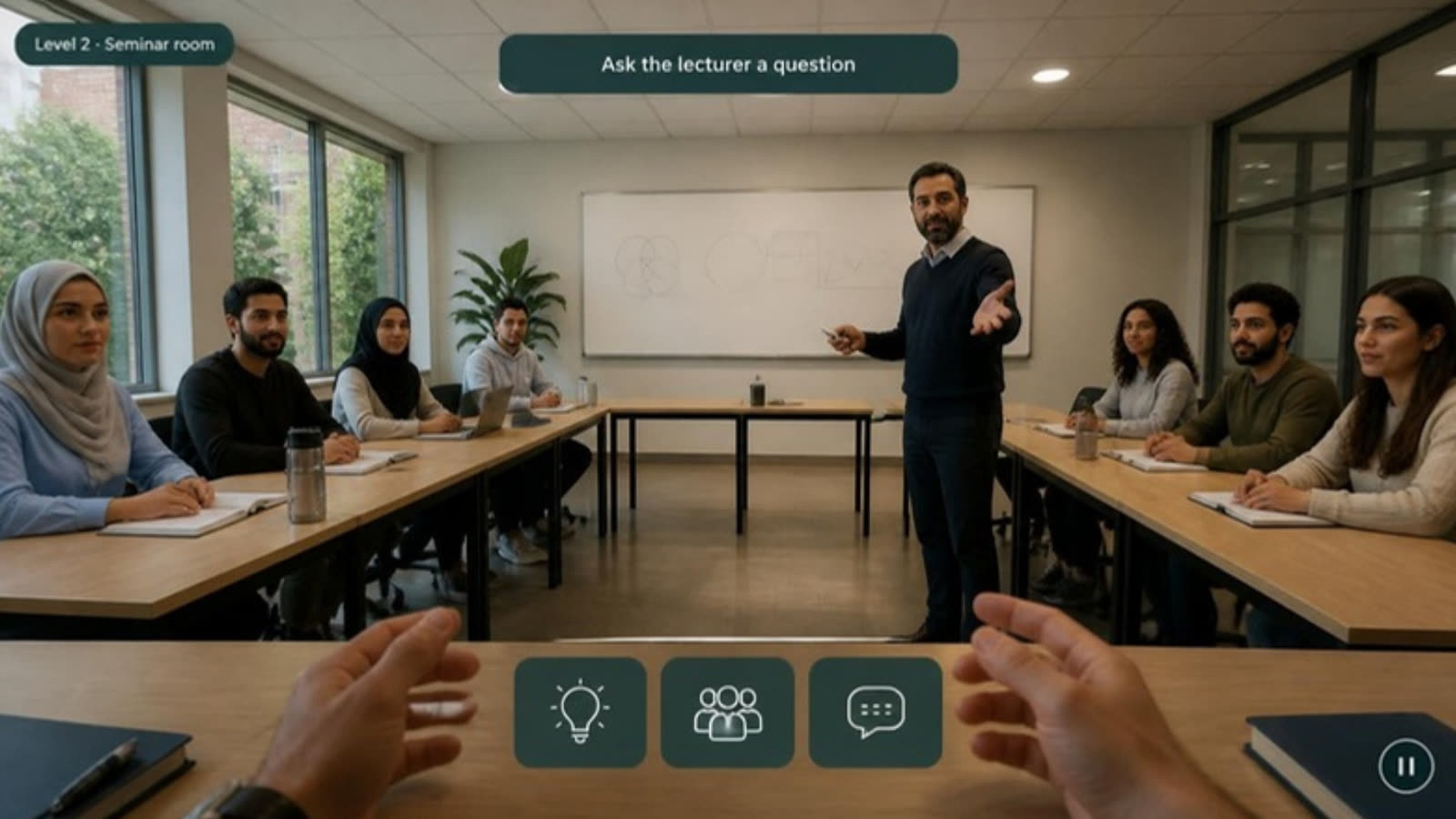
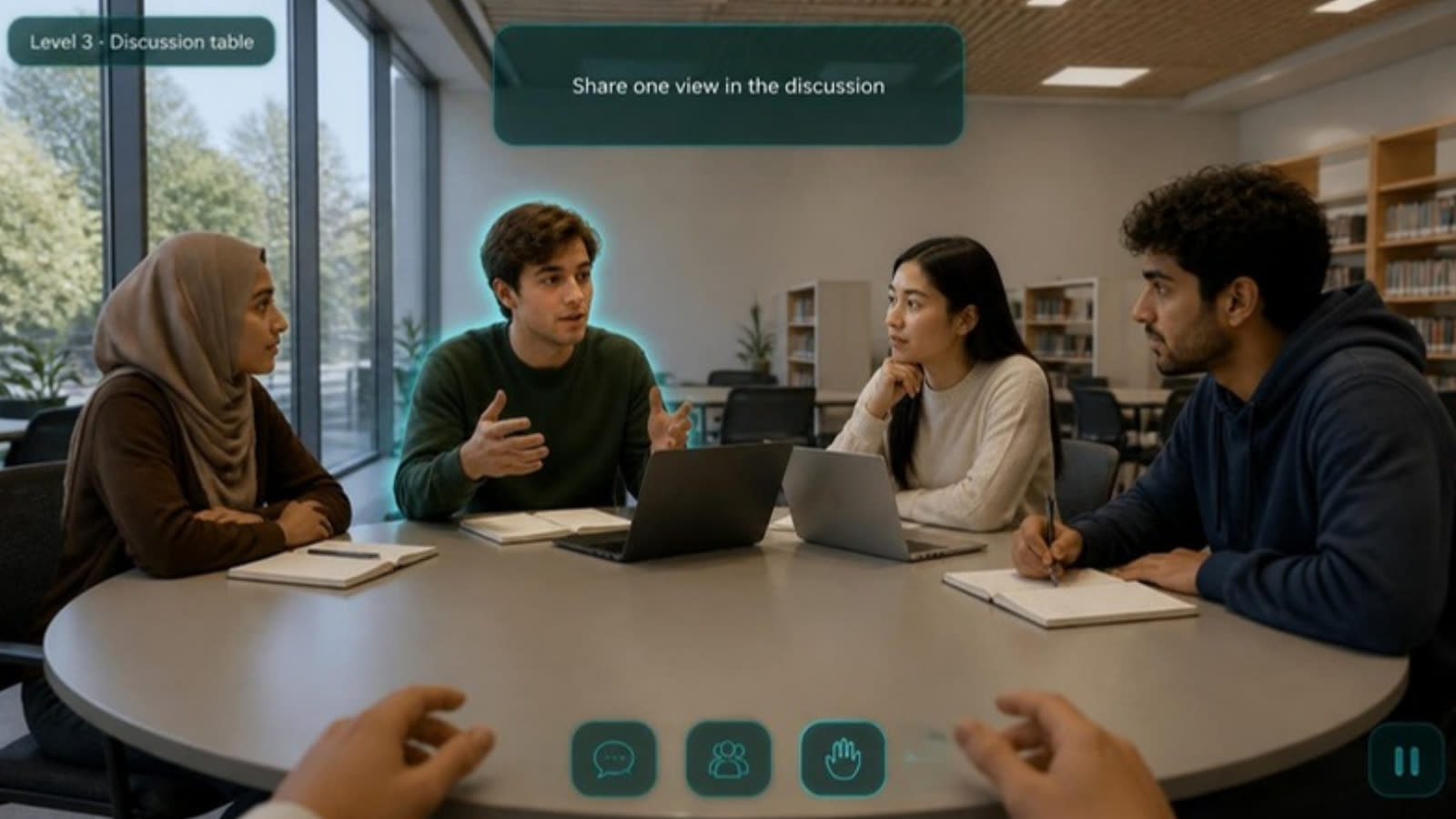
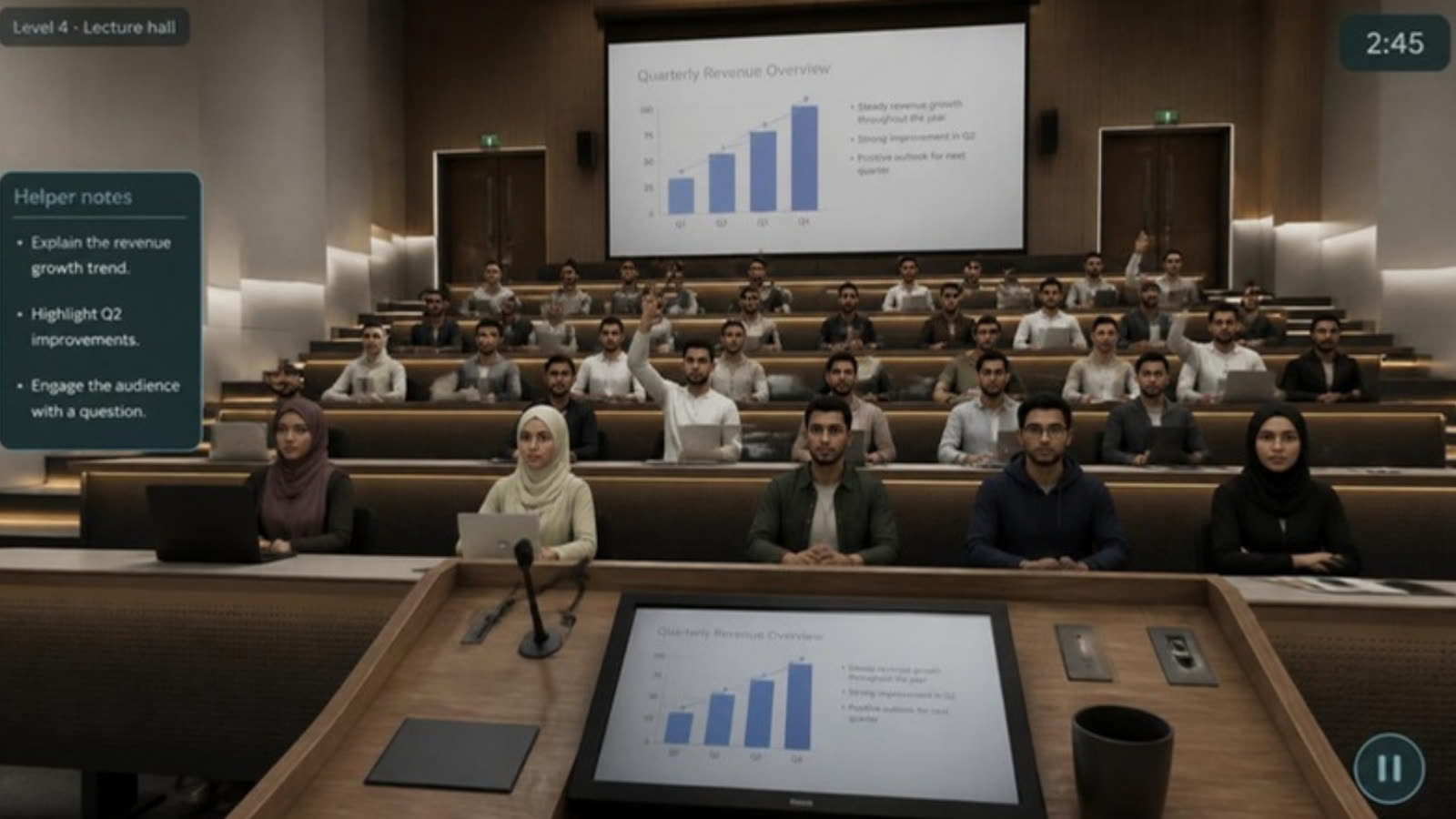
Designed as a mission-based game for university students: clear levels, a free choice of challenge, and progress measured only against oneself.
3 friendly classmates; answer a question you know
10 students; ask the lecturer a question
Group discussion; share a view and disagree politely
30 students; a short presentation with questions
Take part in a real class
A ringing phone, a latecomer, a tough question. The student picks what to add, and each challenge earns more points.
Unlocked with progress and used during class: ask for the question again, take time to think, return to your notes.
Compared only with your previous attempt, which you can replay. No leaderboards between students.
The first discussions and talks are on a topic the student loves, building from their strengths.
In anatomy education, extended reality produced larger gains when used to supplement teaching (SMD = 0.52) than overall (SMD = 0.40), across 27 studies and 2,199 students. [5]
In one feasibility study, negative effects occurred in 9% of sessions (12 of 129), none serious; in another, 4 of 29 participants withdrew because of cybersickness. [14]
04
A two-arm randomized controlled trial over 16 weeks that isolates the effect of immersion: both arms receive the same content and the same time with a facilitator, and the only difference is the headset.
Building the virtual classroom in both versions, with ethics approval and recruitment in parallel, and prototype testing with a few students.
24 students, a baseline seminar task, then randomization.
12 sessions, twice a week, with a real-world task each week.
Primary outcome in week 15, follow-up in week 16, then the final report.
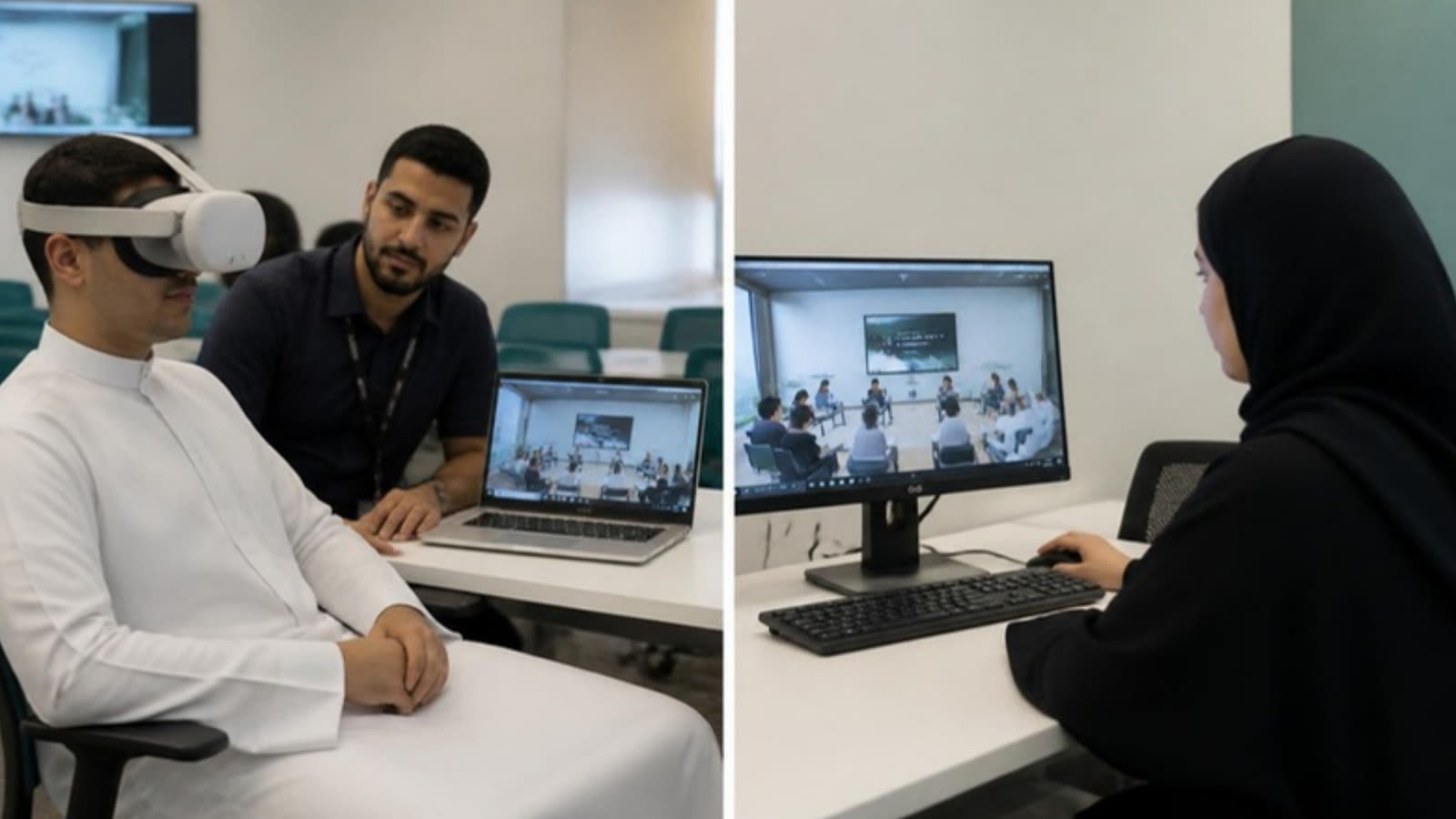
| Participants | Enrolled university students aged 18 or over with an autism diagnosis who consent to take part. Students with photosensitive epilepsy are excluded. Women and students who communicate by text or AAC are actively recruited, because earlier studies underrepresent them. [4] |
|---|---|
| Randomization | 1:1, computer-generated, run by a team member not involved in sessions or rating. |
| Primary outcome | Number of contributions, spoken, typed or by AAC (answers, questions, discussion turns and clarification requests), in a real 15-minute seminar task at week 15, with team members acting as lecturer and classmates, video-rated by two raters blind to group. Presentation quality within the task is rated with the PSCR, its nonverbal item adapted so eye contact is not scored. [16] |
| Secondary outcomes | Public-speaking anxiety (PRPSA, translated and back-translated into Arabic), cybersickness (SSQ), usability (SUS), maintenance at 2 weeks, and the number of real contributions in lectures during follow-up (questions, answers or presentations), as logged by the student. [13][9][2] |
| Feasibility criteria | Pre-specified: retention ≥ 80%, at least 9 of 12 sessions attended by 75% of students, no serious adverse events, rater reliability (ICC ≥ 0.75). |
| Sample size | 12 per arm, the accepted rule of thumb for pilot trials. The aim is to estimate the effect, not prove it, and to size a larger trial. [7] |
| Analysis | ANCOVA on the week-15 score adjusted for baseline, intention-to-treat, reporting the effect size with a 95% confidence interval. |
Written to the international SPIRIT 2025 standard (34 items), with a TIDieR intervention description and schedule of assessments. 16 pages.
05
Design the project, run the sessions, act as lecturer and classmates in the live seminar, blindly rate the recordings, and analyze the results.
Builds the virtual classroom in both versions (headset and standard screen) with identical content over 2 months (weeks 1–8), and supports them during delivery.
24 autistic university students, each attending 12 sessions; a few also help test the prototype.
Equipment: 1–2 standalone VR headsets (no PC needed), a development computer, a standard computer and a quiet room.
06
07
The core project is complete in itself within 16 weeks. Any of the following can be added later on the same platform, each as a separate project, depending on resources and priorities.
Attention during a lecture with distractions added step by step, and a personal sensory strategy card used in the real lecture hall.
Starting an assignment: reading the requirements and deadline, breaking the task down and taking the first step, with prompts faded over time.
A virtual interviewer in Jordanian Arabic and English. It has the strongest evidence of a real outcome: in a US trial with a computer-based simulator, 25% found work vs 0% of controls. [17]
Practice requesting academic adjustments, with a personal access profile, measured by genuine requests submitted.
A 360° replica of the actual campus and Amman routes, measured by independence on an unfamiliar real route, plus a campus sensory map.
More students, a third usual-support group and 3- and 6-month follow-up, with a sample size calculated from this project's results.
08
The first controlled trial in Jordan of virtual training in academic interaction for autistic students, and a direct estimate of the added value of immersion. At least one peer-reviewed paper.
A ready Arabic–English training platform that stays at the university after the project, directly benefiting students.
Results within 4 months, ready to support an external grant application.
09
| Risk | Mitigation |
|---|---|
| Slow recruitment due to under-diagnosis or non-disclosure | Recruitment starts during the build, extending to nearby universities if needed |
| Development runs past 2 months | Only one module is built, the screen version shares the same code, and features are frozen in week 7 |
| Ethics approval takes longer than planned | Submit a complete file in week 1; the build continues in parallel |
| Cybersickness or sensory discomfort | Seated default, short blocks with breaks, a standard-screen fallback |
| Raters learning a student's group | Raters did not train the student, and ratings are made from video |